
Old German Handwriting Transcription
Crafted by a von Pfeilitzer-Franck Descendant
Professional Transcription of Old German Handwritten Documents

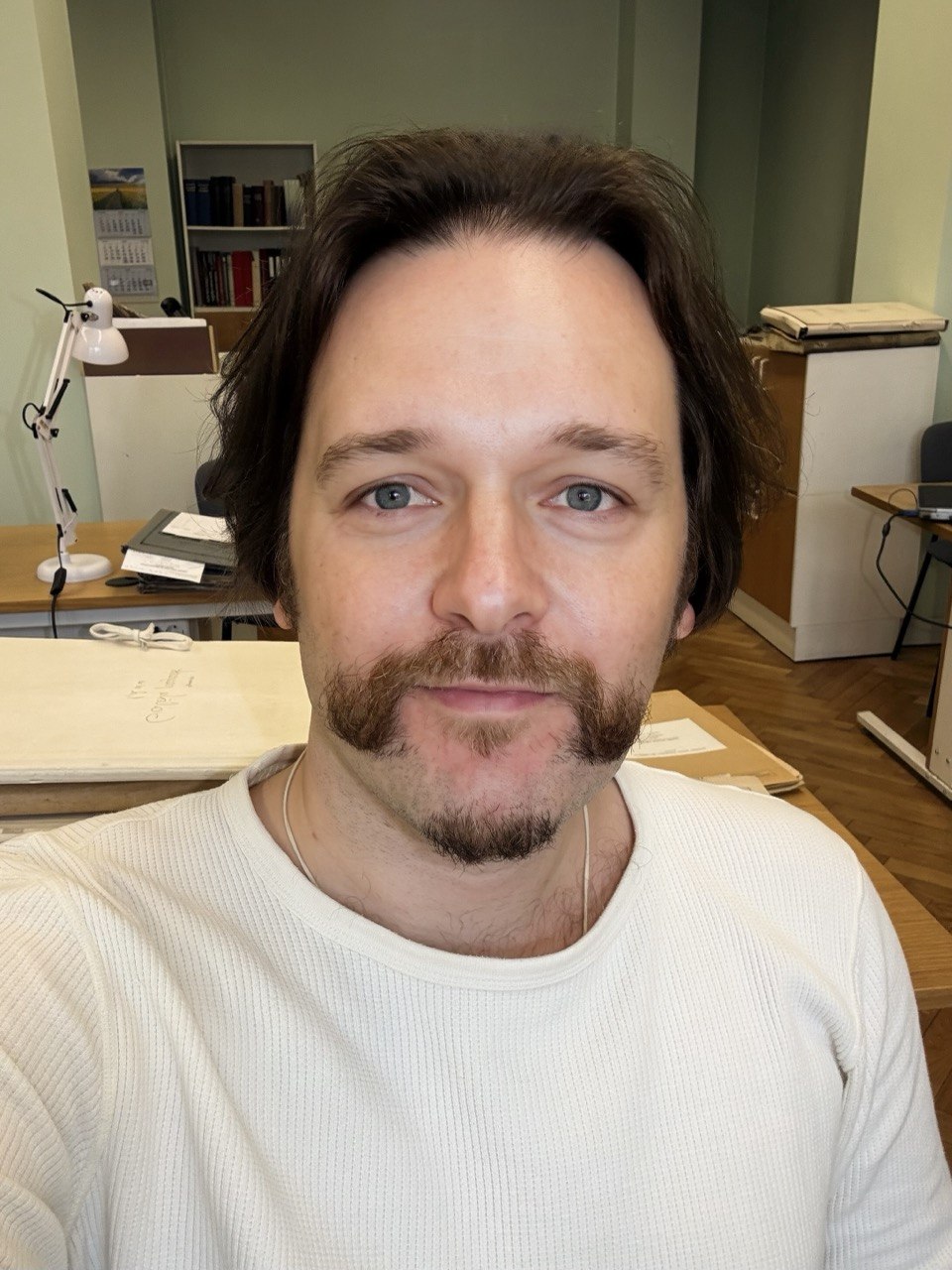
Dear Ladies and Gentlemen,
My name is Artem Vasilev, and by profession, I am an industrial journalist. For more than 15 years, however, I have also been working with German-language archival documents — initially for my own genealogical research, and later on behalf of other passionate researchers. My research interests and experience primarily cover the archives of the Baltic States — Latvia, Estonia, Lithuania — as well as Germany.
Here and now, I am not offering archival search services, but rather transcription — that is, the deciphering of handwritten documents in old German script (Kurrentschrift, Sütterlin). These scripts, commonly referred to as “Gothic,” are a challenge even for native German speakers, as the old calligraphy differs significantly from what is used today. The documents you can have transcribed with my assistance may come from any state or institutional archive — or from your own family collection.
What kinds of documents are worth transcribing?
All sorts of petitions
that your ancestors submitted to various institutions, describing their life situations
Court hearing protocols
which often contain vivid stories involving your relatives and can even help reveal their characters
Documents from institutions
where your ancestors applied for official confirmation of their social status
Real estate documents
such as deeds of sale or inventories, which may contain fascinating details about everyday and economic life
Personal files
from educational institutions, military, or civil service records of your ancestors
Letters, diaries
and much, much more.
There is one exception — documents I do not transcribe: these are short, isolated entries from church books (baptisms, confirmations, marriages, deaths). You can find volunteers to help you read such entries for free: simply search for “German Transcription” on Facebook, for example, and post your request in the relevant groups you find there. However, if you wish to have a more substantial amount transcribed (a full page of continuous text, several or many sheets of documents), please feel free to contact me.
At the end of every calendar year, I set aside an entire day to test the current generation of machine and AI solutions specifically for transcribing German Kurrent script. I try all models available on the market (always in their paid versions, with full functionality enabled). I measure the error rate, the time it takes to upload, process and organise the results, and, most importantly, the time and effort required to compare everything with the original manuscript and correct the errors.
Test results from November 2025
On the same sample text, written in a fairly neat and not particularly difficult hand, the available solutions (and here I only count those that actually recognise text rather than hallucinate it) produced between 3% and 16% incorrectly recognised words, including both grammatical distortions and completely wrong readings. In practice, this means false entries in every third to every single line of the manuscript. This significantly distorts the overall meaning and makes the material, in that raw form, barely suitable even for machine translation: while errors in function words can often be corrected manually or with AI, the appearance of words or clusters of letters that are not in the original document at all inevitably leads to false interpretations of the facts of the case.
In the end, my “test drive” showed the following: the time needed to process and correct the output of an automatic transcription of a simple hand – including detecting and fixing all errors – is roughly the same as the time I spend transcribing the very same text manually (and I type quite fast, touch-typing and without looking at the keyboard).
Pros and cons
Training your own model to get even better results? This can make sense if you are dealing with a very large set of documents all written by the same person. In archival files, however, you usually encounter such a patchwork of different hands that within one file you will have pages on which a custom-trained model performs very well (with only a few percent of errors) and others on which more than half of the words are misrecognised. At least, that has been my experience: the time invested in training a model for a specific corpus (say, a few dozen or even a couple of hundred pages) exceeds the time it would take to transcribe them manually – and you still cannot avoid checking and correcting the results afterwards.
When you transcribe line by line, it is crucial to keep the overall context and argument of the document in view. Current machine models are not yet capable of this. And if you add an additional AI “post-processing” step on top of the machine transcription, the AI starts hallucinating: it arbitrarily replaces words with similar ones and invents things that were never in the original document. If you do not read Kurrent yourself, there is simply no way to reliably detect such surprises.
You also have to take into account the specific ways in which personal names, place names, obsolete terms and dialect forms appear in an old manuscript created in a particular region. At a genuinely professional level, all these tasks can, for the time being, only be handled by a real human being who has mastered the art of reading old German scripts.
And finally, professional transcription is indispensable if you plan, now or later, to publish anything based on the transcribed documents.
So here is my answer and recommendation —
yes, you can use AI if:
- you yourself have a sufficiently confident command of German (ideally you can read Kurrent, even if slowly) to critically review the machine output;
- you have made sure that you are uploading your documents into a tool that recognises actual text rather than inventing it;
- you have the time and patience to compare the result word by word with the manuscript and correct it;
- you are transcribing only a modest amount of text;
- or you simply need a general idea of the content and type of the document, accepting a likely loss of detail and of the authentic texture of the file.
If, however, you do not have that much free time and stamina, or if you need:
- a transcription of a longer text or an entire archival file consisting of many pages;
- a transcription in which nothing has been made up;
- a transcription you are not embarrassed to quote, because it is accurate, free of lexical distortions and semantic hallucinations, and all grammatical and orthographic fluctuations reflect the linguistic norms of the period in which the document was created, or the author’s individual style;
- a transcription that you can confidently use for publication, whether in a blog, an academic paper or a journal;
— and especially if you have already spent time, nerves and perhaps money experimenting with machine and AI tools, only to conclude that your particular documents require expert manual work —
then I will gladly take this burden off your shoulders and work carefully through your documents for you.
How to order a transcription?
You can send me photocopies or scans of your materials by email (please do not reduce the file size — send images in the highest available original resolution, or provide a direct link to download a folder/archive from cloud storage). I will assess their legibility and estimate the turnaround time (I usually take on scripts from the late 18th, 19th, and 20th centuries right away; for earlier periods, it depends on the specific case).
You are welcome to write to me in English, German, or Russian. In principle, you can send your request in any other language as well — I will read it using machine translation and reply in the same way for your convenience.
How much does it cost?
You can estimate the approximate cost yourself in advance: I charge €0.10 per word transcribed (this is the lowest rate I have seen among my colleagues). In rare cases of particularly original or careless handwriting that I am nevertheless willing to take on, we will agree in advance on a higher rate for specific pages in your set of documents. Any portions of text that cannot be transcribed, or words I am not confident about, will be excluded from the fee.
Only from German?
As a native Russian speaker, I can also transcribe documents in Russian for you (I know this is relevant for many whose ancestors once lived in Russia). And although this website is dedicated to German transcription, you are welcome to request work with Russian-language documents if that is relevant for you.
Some advantages of working with me:
- I am not as heavily booked as full-time academic staff in Germany, so the turnaround time for your order will likely be faster and without extra rush fees.
- I am registered as a sole proprietor in a European jurisdiction, so I will issue an official invoice, and you can pay by bank transfer (card-to-card transfers and top-ups via neobanks like Revolut or Wise are also available). Please note that an additional 21% VAT will be added to the invoice amount, as transcription services in my jurisdiction (I am registered in Spain) are not exempt from VAT.
- I respect your research interests: after completing your order, I will delete all original files and the transcription result from my devices — so you can rest assured that you retain all rights to these materials, including the right of first publication.
- If you are not a native German speaker, as a complimentary bonus to your order, I will provide a translation of the transcribed text into another language of your choice (for example, English or Russian), so you can immediately share your discoveries with family and friends.
- You can get to know me “remotely” by reading fascinating stories (including publications based on transcribed archival documents) that I periodically post on the family page “The History of the von Pfeilitzer-Franck Family” on Facebook.
It would be wonderful if even more family history researchers could learn about the fates and characters of their ancestors from archival sources that are not always easy to read. I hope I can be of help to you in this endeavor.
Wishing you rewarding discoveries on your journey through the past,
Artem Vasilev